

The inspection methods, procedures and precautions of micro-tillers
The micro-tiller is a portable field management machine powered by a small diesel or gasoline engine, which drives the rotary tiller blade shaft to rotate through belt or gear transmission to complete operations such as ploughing, soil crushing, furrow digging, and ridging. It is widely used in narrow plots such as hilly and mountainous areas, greenhouses, orchards and tea gardens where large and medium-sized agricultural machinery cannot enter. It is a key equipment to replace traditional ox plowing and reduce the labor intensity of farmers. Due to its compact structure, hand-held walking operation mode, and the fact that its working environment is mostly on the ridges and slopes of fields, the safety risks of micro-tillers (such as knife injuries, machine overturning and loss of control, drive belt breakage and ejection, etc.) cannot be ignored. In scenarios such as the purchase and acceptance of new machinery, the verification of batch agricultural machinery subsidies, second-hand transactions, and the asset inspection of leasing service teams, a systematic inspection covering power, transmission, working components, and safety protection is a fundamental means to ensure the quality of farming and the personal safety of operators.
I. Overview of Inspection Methods
According to the power form (diesel engine/gasoline engine), transmission mode (gear transmission/belt transmission/chain transmission), functional configuration (rotary tillage/furrow opening/ridging/water pumping, etc.) of the micro-tiller and the entrusted requirements, the following methods are comprehensively applied for inspection:
Static full inspection: The micro-tiller is left stationary, and each item of the engine, frame, clutch, transmission, transmission system, rotary tiller blade assembly, traveling wheels/resistance rods, handrail frame, safety protection devices, etc. is visually inspected one by one, and measured by touching the measuring tools with hands.
Dynamic operation test: Start the engine in a safe area to verify functions such as idle speed, acceleration, clutch engagement and disengagement, operation of each gear, rotation of the rotary tiller shaft, and steering clutch. Listen for any abnormal sounds or vibrations.
Trial tillage verification (as needed) : Conduct short-term trial tillage in fields where conditions permit, measure core indicators such as tillage depth, tillage width, soil fragmentation rate, and operation efficiency, and comprehensively evaluate the overall tillage quality of the machine.
Document and nameplate traceability: Verify the consistency of the nameplate of the entire machine, the engine nameplate with the certificate of conformity and the promotion and appraisal certificate (if subsidies are involved).
The third-party inspection is based on the execution package of "static full inspection + dynamic operation test + functional verification". When it comes to the verification of agricultural machinery subsidies, it is necessary to additionally check the consistency between the promotion appraisal certificate and the machinery number.
Ii. Inspection of the entire process
1. Data collection and inspection preparation
The client provides a list of micro-tillers to be inspected, clearly stating the manufacturer, model, matching power (model/power/speed), transmission method, standard working width, configuration functions (rotary tiller/furrow opener/traveling wheel/water pump, etc.), factory serial number, and applicable standards (such as JB/T 10266, NY/T 502, etc.). The inspection party prepares: tape measures, vernier calipers, steel rulers, Angle gauges, tachometers, infrared thermometers, soil hardness testers, tillage depth measuring rulers, etc.
2. Confirmation of the venue and safety status
Static testing is carried out on a hard and flat ground. Trial plowing must be carried out in representative fields, and there should be no obstacles in the operation area. Inspectors wear safety helmets, anti-crush shoes and long pants (to prevent accidental rotation of knives from injuring people). When checking or replacing the cutting tool, it is necessary to confirm that the engine has been turned off, the high-voltage wire of the spark plug has been unplugged (for gasoline engines), or the decompression handle has been locked.
3. Identity and nameplate verification
Whole machine nameplate: Check the manufacturer, model, factory serial number, matching power, working width, and manufacturing date.
Engine nameplate: Check the model, rated power/speed and serial number to ensure they are consistent with the information on the nameplate of the entire machine and the certificate of conformity.
Promotion appraisal certificate (subsidy verification) : Verify that the model and manufacturer on the certificate are consistent with the physical item and confirm that it is within the validity period.
4. Engine Inspection - The core power of micro-tillers
Starting performance: Gasoline engine - It should start within 3 to 5 times after closing the choke and pulling the starting rope. Those with electric start function must be verified together. Diesel engine - Start under reduced pressure or by hand crank, and start smoothly after operating in accordance with the procedures. If starting is difficult, the reasons should be recorded (such as carburetor/fuel injection pump failure, insufficient cylinder compression pressure, etc.).
Idle speed and acceleration: Stable idle speed, no automatic stalling, no idling. The rapid acceleration response is sensitive and the exhaust smoke color is normal. The exhaust of a gasoline engine should have no obvious black smoke, while a diesel engine is allowed to have a slight black smoke but it should not be sustained.
Governor function: Quickly change the position of the throttle handle, and the engine speed should respond promptly and stabilize at the corresponding speed. A malfunction of the governor will cause the engine to stall or run out of speed.
Three leakage checks: No oil leakage in the engine body (oil pan, fuel tank switch, carburetor/fuel injection pump), no air leakage (exhaust pipe interface, cylinder gasket), no water leakage (water tank type diesel engine). Oil leakage from the carburetor of a gasoline engine is a common cause of starting failure.
5. Transmission system inspection - Reliability of power transmission
The transmission chain of the micro-tiller is: engine → clutch → gearbox → knife shaft/traveling wheel. Each link must be inspected one by one.
Clutch: Hand-guided micro-tillers mostly adopt tensioning wheel clutches (belt drive type) or friction plate clutches (gear drive type). When operating the clutch handle, the engagement should be smooth and the disengagement thorough. When combined, there should be no abnormal slippage noise. When separated, the tool shaft should stop rotating within 3 seconds - incomplete separation is one of the main causes of tool injury accidents.
Drive belt/pulley: Belt drive type - Check the wear of the V-belt, cracks at the bottom of the groove, and tension. Belt aging and breakage are the most common field faults of micro-tillers. Wear at the bottom of the pulley groove (deepening and widening) will cause the belt to slip.
Transmission: Check the transmission oil level (oil window or dipstick). The oil color should be normal and there should be no emulsification. All gears (forward 1-2 gears, reverse gear) are smoothly engaged without any gear disengagement or skipping. There is no abnormal noise or oil leakage from the transmission during operation.
Steering clutch: Micro-tillers usually achieve differential steering by relying on left and right steering clutches. Operate the left and right steering handles respectively. The corresponding side traveling wheels should be able to disengage power to achieve differential steering with one side stopped from rotating. Slippage or malfunction of the steering clutch will cause the operator to be unable to control the direction.
6. Inspection of rotary tiller blade assembly - Core working components
Blade wear and damage: Rotary tiller blades (usually curved blades or chisel-shaped blades) are the components with the highest consumption. Check the degree of blade wear - a blunt knife will significantly increase tillage resistance and fuel consumption, and the rate of soil fragmentation will decrease. Check if the blade is severely deformed, cracked or has missing edges. The blade fixing bolts/nuts are tightened and the anti-loosening gaskets are in good condition.
The status of the knife shaft: When manually turning the knife shaft, it should rotate smoothly without any jamming. The bearing housing of the knife shaft is free from looseness and oil leakage (the oil seal is intact). The installation directions of each blade on the knife shaft are correct - usually the curved blade edge faces the rotation direction. Incorrect installation will result in the inability to enter the soil.
Blade arrangement: The blades should be arranged in a spiral order on the blade shaft, with symmetry on both sides. Incorrect arrangement will lead to unbalanced farming and machinery tilting to one side.
7. Inspection of walking and working accessories
Walking wheel: The wear condition of the tread on rubber tires or iron wheels. Excessive wear of the iron wheel's ground grip teeth will cause slipping in the field. The clearance of the bearing housing of the traveling wheel is normal.
Resistance rod/deep ploughing rod: The resistance rod (a key component for adjusting the ploughing depth) has no bending or deformation, the adjustment holes are clear, and the fixing pins/bolts are complete. The Angle and depth of the resistance rod entering the soil are adjustable, and the adjusting mechanism is flexible and reliable.
Rotary tiller mudguard/protective cover: The mudguard is firmly fixed without severe rust or deformation. The rubber curtain at the rear of the mudguard is intact to prevent people from being injured by flying debris.
Furrow opener/ridger (if configured) : Check the condition of the furrow opener disc or ridger. The clearance of the connecting pin shaft is normal.
8. Inspection of the handrail frame and control system
Handrail frame: The height of the handrail frame is adjustable (usually 2-3 steps), and the adjustment mechanism is reliably locked. The handrail frame pipe body has no severe deformation or cracking.
The layout of the control handles: The clutch handle, throttle handle, steering clutch handle, and reverse gear handle (if any) should be arranged reasonably, operate flexibly, and the rubber sleeves of the handles should be intact without falling off.
Throttle handle: The throttle handle should be adjustable smoothly throughout the entire stroke and be equipped with a "stop" or "minimum stable speed" limit. After release, it should be able to automatically return to its original position or remain at the set position.
Safety grip (emergency stop device) : Some micro-tillers are equipped with a safety grip at the end of the handrail frame - once the operator releases it, the engine should automatically shut off or the clutch should automatically disengage. This is the most important safety protection function and must be tested effectively.
9. Safety protection device inspection - the top priority in safety inspection
Belt/chain guards: The output pulley of the engine, the input pulley of the transmission and the drive belt must be equipped with intact guards. The protective cover is undamaged and firmly fixed. Any loss or damage is judged as a serious safety non-conformity.
Rotary tiller blade protective cover: There must be a fixed protective cover (mudguard) above the blade shaft. During operation, it should cover the top and back of the rotating blade to prevent the operator's feet from mistakenly entering the rotating area.
Exhaust pipe protection: The high-temperature section of the exhaust pipe should be equipped with a protective net or heat insulation cover to prevent operators from being scalded.
Safety warning signs: The machine body should have clear safety warning signs such as "Do not touch when the tool is rotating" and "Do not approach rotating parts". The detachment of the label should be recorded.
10. Dynamic operation test
In a safe open space, start the engine and let it idle for 3 to 5 minutes to warm up:
No-load operation: Increase the throttle to the working speed, engage the clutch, and the tool shaft rotates. Listen for any abnormal sounds from the knife shaft bearings and whether the knife shaft operates smoothly. When disengaging the clutch, the knife shaft should stop within 3 seconds. Engage and disengage the clutch three times repeatedly to verify its reliability.
Gear shifting: When the vehicle is stationary, shift each gear and engage the clutch respectively to verify that the transmission of each gear is normal.
Steering clutch test: Operate the left and right steering handles respectively to confirm that the corresponding running wheels can be disengaged from the power (belt drive type) or that the steering clutch is working properly (gear drive type).
Throttle response: When the throttle handle is quickly pushed or pulled, the engine speed should respond flexibly.
Vibration inspection: When the entire machine operates at the rated speed, the vibration amplitude of the handrail frame should be within an acceptable range. Abnormal and severe vibration indicates that the dynamic balance of the knife shaft is disrupted (uneven or missing blade configuration) or the engine fixing bolts are loose.
Noise: Ear noise is quickly screened out using a sound level meter. Excessive exhaust or mechanical noise should be recorded.
11. Trial tillage test (as needed)
Conduct short-distance trial plowing in representative fields:
Depth measurement: Use a depth measuring ruler to measure at multiple points and compare it with local agronomic requirements (usually 12-18cm). The depth of ploughing should be uniform and consistent.
Tillage width: Whether the measured tillage width is consistent with the nominal value.
Soil fragmentation rate: By visual inspection or sampling and screening, the size of the soil lumps after ploughing should be uniform, without a large amount of large soil lumps 垡.
Work efficiency: Observe whether the traveling speed at the specified gear is normal and whether there is a significant decrease in the speed of the tool shaft due to belt slippage.
Operational comfort: Whether the vibration of the handrail frame is controllable and whether the direction control is flexible.
After the trial plowing, recheck the temperatures of the blades, belts and gearboxes (detected by an infrared thermometer, and they should not be abnormally overheated).
12. Report output
Summarize all inspection items, measurement data and trial tillage records to form the "Third-Party Micro-Tiller Inspection Report". The report must particularly indicate the integrity of the safety protection devices. For the verification of agricultural machinery subsidies, the report must include the certificate number of the promotion appraisal, the verification conclusion, and a comparison photo of the nameplate and the physical object.
Iii. Precautions
Safety protection devices - The "zero-tolerance" item for micro-tiller inspection
The absence of belt/chain guards is the most common safety hazard of micro-tillers. When working in the field, operators wearing loose clothing, trouser legs, shoelaces, etc. are prone to being caught in the exposed rotating belts, causing serious personal injury. Any absence or damage of the protective cover during the inspection must be judged as safety non-compliance.
Incomplete disengagement of the tool shaft - that is, the tool shaft still rotates inertially or continues to rotate with the engine after the clutch handle returns to its original position - is the direct cause of tool injury accidents. The stop time of the tool shaft must be measured. It should stop within 3 seconds. If the separation is not complete, it is necessary to check whether the clutch tensioner wheel is fully reset and whether the belt is stuck to the pulley.
If the "release and stop" safety grip is equipped, its effectiveness must be tested. This is the last line of defense that automatically cuts off power when the operator falls or loses control.
Rotary tillage blades - a dual carrier of operation quality and safety
When the blade is severely worn or broken, not only does the soil crushing effect deteriorate, but the broken blade also flies out during high-speed rotation, resembling shrapnel, which can cause serious personal injury. When inspecting, each piece must be checked for cracks and deformations. Any blade with cracks must be replaced immediately.
Incorrect installation direction of the blade is a common operational mistake made by beginners. The inspector should confirm that the cutting edges of all blades are facing the direction of rotation, and the bending directions of curved blades are consistent. Installing it in the wrong direction will prevent it from being properly inserted into the soil and cause severe vibration of the knife shaft.
Drive belt - The "weak link" in field operations
Micro-tillers mostly adopt single or double V-belts for transmission. Belt aging and cracking, as well as hardening at the bottom of the groove, are precursors of belt breakage. A belt breakage not only interrupts the operation, but at the moment of breakage, the belt may fly out and injure the operator or damage the protective cover. When inspecting, the belt must be removed and bent in reverse to check for cracks at the bottom of the groove.
Improper belt tension - if it is too loose, it will slip and smoke under heavy load; if it is too tight, the belt and bearings will wear out sharply. Press the middle of the belt. The deflection should be within the range specified by the manufacturer.
Transmission Fluid - The Overlooked "Invisible Killer"
The gearbox of a micro-tiller is usually lubricated with gear oil. Users often neglect to change the oil. After long-term use, the oil emulsifies (water enters), oxidizes (turns black), or contains metal debris. Emulsified gear oil has extremely poor lubricity, which will cause gears and bearings to wear out and become scrapped within a short period of time. When conducting the inspection, an oil level check hole must be opened to observe the state of the oil. Any emulsified or severely deteriorated oil should be recommended for replacement.
Engine oil - The "lifeline" of gasoline engines
Insufficient engine oil is the primary cause of cylinder pulling and bearing seizure in a four-stroke gasoline micro-tiller. The oil level on the dipstick must be checked before inspection. If the oil level is too low or the engine oil turns black and deteriorates, it should be clearly recorded in the report and prompted to change the engine oil immediately before starting the test run.
For a two-stroke gasoline engine micro-tiller, it is necessary to confirm that the fuel has been mixed with engine oil in the right proportion. Running it purely with gasoline will cause the engine to be scrapped due to cylinder pulling within a few minutes.
Special requirements for subsidy verification
If the purpose of the inspection is to verify agricultural machinery purchase subsidies, the following additional measures must be taken:
Verify that the number of the promotion and appraisal certificate is exactly the same as the nameplate of the physical object.
Check whether the engine number and the factory number of the entire machine are consistent with those in the subsidy application materials.
Confirm that the equipment has been actually configured in place and there is no phenomenon of "empty set subsidy".
Take a group photo of the machine and the inspector (with the inspected micro-tiller in the same frame) as verification evidence.
Key points of the photo archive
Close-up of the entire machine nameplate, close-up of the engine nameplate, the condition of the belt guard, the wear condition of the rotary tiller blade (multi-piece arrangement comparison photo), close-up of the tool shaft bearing housing, the oil level and oil condition of the transmission, safety warning signs, and the measurement process of the ploughing depth during the trial ploughing all need to be independently and clearly archived.
分享这个商品
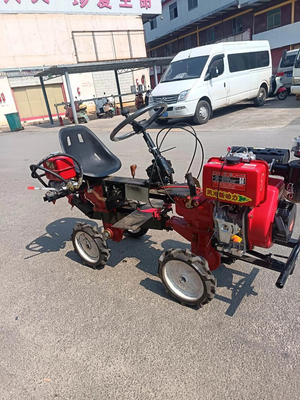
The inspection methods, procedures and precautions of micro-tillers
The micro-tiller is a portable field management machine powered by a small diesel or gasoline engine,