

Excavator Repairs Recognition Technique: Remove "Beauty Filters", Restore True Vehicle Condition
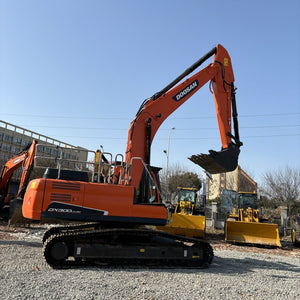
In the second-hand market, many excavators have undergone professional refurbishment, and their appearance is comparable to that of new machines. However, refurbishment does not necessarily mean a good vehicle. One must learn to strip away the "beauty treatment" in order to truly understand the true condition.
I. The Secret Beneath the Finish Coat
Measure thickness to find "patches"
The original paint has uniform thickness (80 - 120 μm). Use a paint film scanner to scan the boom, bucket arm, and cab:
The local area suddenly rose to over 300 μm → The plaster was used to fill the gap, and there were cracks or depressions below.
The overall machine value is too high → The entire vehicle needs a complete repaint. This might be done to cover up extensive rust or an accident.
Observe "flowing paint" and "boundary lines"
Refurbishment spray painting often has edge drips, residual paint on the rubber strips, and the edges of the nameplates being covered. The original factory coating has clear boundaries and no over-spray.
Polish the "test window"
Use fine sandpaper to gently rub in inconspicuous areas (such as the bottom of the counterweight block), revealing the underlying surface:
Two layers of paint → Normal repair
Third floor and above → Multiple renovations, this area has repeatedly suffered damage
II. Camouflage within the welds
Comparison of weld texture
The original factory weld seam is uniform and fine (automatically welded). The refurbished weld seam is rough, with many pores and edge undercutting. When touched by hand: the original factory weld seam is smooth, while the refurbished weld seam feels rough.
Magnetic Particle Inspection (Simplified Version)
Use a small magnetic particle inspection instrument to scan the key weld seams (at the root of the arm and the connection point of the turntable). At the locations with cracks, the magnetic particles gather to form lines. This phenomenon does not occur in the original factory weld seams.
Impact sound detection
A small hammer gently taps both sides of the weld seam:
Clear and resonant sound → Complete base material
Dull and harsh sound → There are layers or incomplete fusion inside
III. Age Evidence of Rubber Components
Cab shock absorber block
The original factory date code (molded) should match the machine's year. If the shock absorber block is very new but the surrounding area is dirty and old, it indicates that it was recently replaced and the original vehicle may have a history of severe vibrations.
Hydraulic hose batch
Check the 6-digit production date code (week/year) on the hose. If all the hoses on the vehicle have the same year and are close to the year of the entire vehicle, it is normal; if there are both new and old hoses, it indicates that some pipes have burst and the hydraulic system has experienced a serious malfunction.
Track rubber pads (rubber tracks)
The rubber becomes hard and cracked, even if the pattern is deep, they need to be replaced. Press with your fingernail: if it is elastic then it's fine; if it is as hard as plastic, then its lifespan is coming to an end.
IV. "Rotation Marks" on Bolts
Misalignment of the highlighted marks
The original factory key bolts (for the slewing bearing and the root of the boom) have torque marks. If the marks are significantly misaligned by more than 3mm, it indicates that the bolt has been removed and this part has undergone major repair.
Flattening of the gasket
Check if the spring gasket is flattened and if the teeth of the gear-shaped gasket are worn. Abnormal deformation indicates that the bolt has endured excessive vibration or has been repeatedly disassembled.
Corrosion and fresh screw marks
For the same bolt: The edges of the head are worn, there is old rust inside the slot, but there are fresh screw marks on the side → Recently it was just tightened, attempting to cover up the internal problem.
V. The Truth Beneath the Panels
Open the side door to inspect the cabin
Renovation is only on the surface; the interior of the cabin is where the truth can be fully revealed:
A large amount of oil sludge accumulation → Long-term oil leakage that has not been repaired
The various types of wire harness ties → Multiple circuit failures
The fins of the radiator are severely tilted backward → It was once sprayed with high-pressure water from a close distance (covering up the history of high temperature)
The water tank frame is deformed.
Check if the water tank support is tilted. If so, perform welding repair. In cases of accidents at the front part, only the exterior parts are replaced, leaving the frame unrepaired or not repaired properly.
Bottom of the cab
Raise the cab (or lean over to look), rust, welding defects, and wrinkles on the floorboard are conclusive evidence of a rollover or severe side-slip.
VI. Contradictions in the Document
Nameplate and steel stamping
Check whether the nameplate in the driver's cabin, the steel stamping on the frame, and the engine number are all consistent. If they are not consistent → It is a spliced vehicle or a stolen/robbed vehicle.
Maintenance record logic
The hydraulic oil has not been replaced for 5000 hours, but the oil is clear → Just before the sale, new oil was replaced to cover up the aging. Normally, it should be cloudy or dark.
Certification of authenticity of imports
For second-hand excavators from Japan/Europe, original export certificates from the country of origin and Chinese customs tax clearance certificates are required. Both are essential. The copies must correspond to the information on the nameplate.
分享这个商品
Excavator Repairs Recognition Technique: Remove "Beauty Filters", Rest
In the second-hand market, many excavators have undergone professional refurbishment, and their appearance is comparable to that of new machines.