

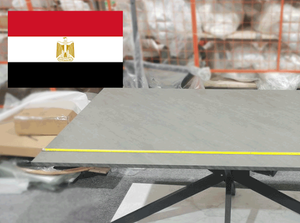
Export to Egypt | Toys, notebooks, paper, sunglasses, furniture and children's care products, etc. comply with mandatory standards
To ensure the smoothness of export trade, all relevant export enterprises are kindly requested to pay close attention to the series of strengthened product entry requirements recently implemented by Egypt. Starting from July 5, 2024, Egypt has officially implemented new mandatory standards for a wide range of goods, including toys, stationery, furniture, and children's products. This move implies that before entering the Egyptian market, relevant products must go through the designated inspection and certification processes and obtain the necessary customs clearance documents.
This standard update is mainly based on Ministerial Decrees No. 499/2023 and No. 502/2023 issued by the Ministry of Trade and Industry of Egypt. Official information indicates that the Egyptian Standards and Quality Management Organization usually reserves a 6-month transition period for manufacturers and importers to comply with the new regulations. For example, some of the standard decrees were approved on December 18, 2023, and came into effect on January 5, 2024. The final deadline for mandatory market implementation is July 5, 2024.
I. Overview of Core Product Standards to Come into Effect in July 2024
The following are some of the Egyptian standards that will be mandatory and their corresponding international reference standards. Exporters should use this information to verify the product specifications:
Product Category Egyptian Standard Number Standard Name (Reference) Corresponding International/Regional Standards Reference
Stationery ES 1119:2023 Notebooks and Exercise Books Japanese Industrial Standard JIS S 5504 /2010
Paper ES 13-1:2023 General Writing and Printing Paper Indian Standard IS 1848-1/2018, etc.
Sunglasses ES 3189-1:2023 General Use Sunglasses International Standard ISO 12312-1/2022
Furniture ES 8742:2023 Safety, Strength and Durability of Household Tables European Standard EN 12521:2015
Toys ES 3123-3:2021 Safety of Toys - Migration of Specific Elements European Standard EN 71-3/2019
Children's Products ES 8754:2023 Safety Requirements for Baby Beds and Stools European Standard EN 1466/2014+A1/2015
Note: In addition to the above standards, the Egyptian Standards Authority is still continuously updating and adding regulatory requirements. For example, two new draft standards for chemical experiment toys and smell table games have been notified through WTO recently (ES 3123-4 and ES 3123-13), and they are currently in the review period. Exporters need to keep track of the regulatory dynamics.
II. Compliance Process for Export to Egypt: Four Steps for Inspection and Certification
According to the regulations of the General Authority for Import and Export Control of Egypt (GOEIC), controlled products must obtain a Certificate of Conformity (CoC) before they can be cleared for customs in Egypt. The entire compliance process revolves around the core step of pre-shipment inspection.
Step 1: Confirm that the product is within the regulatory list
The exporter should first verify whether their product falls within the scope of mandatory inspection and certification in Egypt. The GOEIC regulatory product list is extensive, covering not only the aforementioned new categories but also textiles, footwear, electrical appliances, cosmetics, food, etc. It is recommended to directly visit the GOEIC website or consult a professional agency for verification.
Step 2: Ensure the product complies with Egyptian standards
Before arranging production, make sure to use the Egyptian Mandatory Standards (ES standards) as the basis for product quality. Most Egyptian standards are equivalent or similar to mature international standards (such as ISO, EN, JIS). The safest approach is to send product samples to a qualified laboratory for testing and obtain a test report certifying the product's compliance. This report is one of the necessary documents for subsequent certification applications.
Step 3: Apply for Pre-Shipment Inspection and Conformity Certification
Before the goods are completed and ready for shipment, the exporter needs to apply to the certification authority recognized by GOEIC for a pre-shipping inspection. The basic documents required for the application usually include:
Completed application authorization form (RFC)
Form invoice / Commercial invoice and packing list
Product test report issued by a third-party laboratory
Other such as quality management system certificates (if applicable)
The issuing authority will review the documents and assign inspectors to the storage location of the goods for on-site inspection. The inspection content is not limited to verifying the consistency between product quality and test reports, but also includes checking the quantity, packaging, and labels of the products.
Step 4: Obtain the certificate and complete customs clearance
Once the document review and on-site inspection are both successful, the issuing authority will issue a conformity certificate (CoC). The exporter must submit this certificate to the Egyptian customs as proof that the goods comply with Egyptian standards and technical regulations, and only then can the customs clearance be completed successfully.
III. Relevant Costs and Professional Service Guidelines
Exporters should have a reasonable expectation of the costs involved in this process. According to public information, the certification fee for the CoC is usually calculated at 0.5% of the FOB total value of each batch of goods, and there is a minimum charge (such as $300 per batch). This fee mainly covers document review, on-site inspection, and certificate issuance, but does not include potential expenditures such as the testing cost of the initial products, the cost of repeated inspections due to non-conformity, and overtime pay.
In the face of complex international regulations and inspection requirements, many enterprises choose to collaborate with professional third-party quality assurance service providers. These institutions can offer a full range of services from standard interpretation, product pre-inspection, supplier assessment (factory inspection), to assisting in the completion of official certification applications. This helps enterprises effectively avoid risks such as cargo detention, returns, and even destruction due to non-compliance with standards after shipment, ensuring the stability and reliability of the supply chain.
In summary, the entry barriers in the Egyptian market are systematically increasing. For exporters, planning the compliance inspection and certification process ahead of the product development and production stage, rather than merely treating it as a procedural step before shipment, is a key strategy to ensure smooth trade and maintain business reputation.
分享这个商品
Export to Egypt | Toys, notebooks, paper, sunglasses, furniture and ch
All relevant export enterprises are closely monitoring the series of tightened product entry requirements recently imposed by Egypt.