

Functional Apparel Inspection Guide: UPF, Quick-Dry Performance, and Labeling Blind Spots
Anyone in cross-border export knows that functional apparel has grown fast and carries high margins in recent years. But there have also been many failures. Sun protection clothing with false UPF claims was exposed by CCTV, and a “three-no” product with annual sales of over 300,000 units was forced to stop production. The wave of buyer returns swallowed the entire store’s profit. Quick-dry clothing is even more complex—consumer complaints show that 62% of products have the problem of “absorbing sweat but not wicking it away.” In factory audits and shipment inspections, I repeatedly encounter three blind spots that directly affect whether goods can pass destination-country spot checks.
1. Blind Spot One: Execution Standards—Many Factories Have Not Even Fully Read GB/T 18830
The outbreak of chaos in the 2025 sun protection clothing market was hidden in the packaging bags. The factory sealed in Yiyang County printed “UPF50+” on the bag, but the person in charge told the camera, “Consumers won’t actually send it for testing, so we can write whatever number we want.” Its best-selling style sold over 300,000 units a year. This is not an isolated case. CCTV reporting also found that stalls in the Shaoxing Keqiao fabric and accessory market openly sold non-UV-resistant fabrics, and some suppliers provided forged test reports—even “issuing reports without actual testing.”
1.1 The National Standard Bottom Line for Sun Protection Clothing
The core requirement of GB/T 18830-2009 is simple: UPF > 40 and UVA transmittance < 5%. During inspection, products with a measured UPF below 40 cannot be labeled as “UV protection products.” In 2025, the Shanghai Municipal Administration for Market Regulation sampled 100 batches of sun protection clothing, with a failure detection rate of 16%. UV protection performance failure accounted for 4 batches, and the lowest measured UPF value was only 6. Suzhou conducted a simultaneous spot check of 69 batches, with a failure rate of 4.3%.
1.2 Standard Misconceptions for Quick-Dry Clothing
Quick-dry clothing previously lacked a dedicated standard, and factories often used loose labels that deviated from real performance. FZ/T 73077-2024 “Knitted Quick-Dry Clothing” took effect on January 1, 2025. It upgraded from the previous simple drip test to specific indicators such as moisture absorption and quick-drying performance, and light-sweat composite colorfastness. Many factories still do not know this standard.
Inspection advice: Check whether the hangtag indicates GB/T 18830-2009 and the specific UPF value. UPF50+ is the highest grade. “UPF100+” and “UPF2000+” exceed the labeling range allowed by the national standard. Require suppliers to provide third-party test reports with CMA or CNAS qualifications. Do not accept factory internal laboratory reports. Quick-dry clothing inspection must verify the moisture absorption and quick-drying requirements of FZ/T 73077-2024.
2. Blind Spot Two: Labeling Traps—A Flawless Hangtag Does Not Mean a Flawless Product
In June 2025, the Xinfeng garment processing factory named by CCTV had packaging bags with no product name, factory name, or factory address. Only the “UPF50+” label on the bag was inconsistent with the actual product. Such “three-no” products flowed heavily into the hands of overseas consumers through livestream rooms, and eventually came back to hurt sellers through the return mechanism.
Shanghai’s 2025 supervision spot check found that among 35 batches of sun protection clothing, only half marked the UPF value on the certificate of conformity, and another 18 batches had no UV protection information at all—UV protection function was promoted only through web pages. Without actual third-party spot testing, bulk failure is only a matter of time.
Inspection advice: Shipment inspection must verify four basic pieces of information—product name, manufacturer information, execution standard number, and UPF protection grade. None can be missing. Hangtag and durable label information must be consistent, and care symbols must not be inconsistent or incomplete. If web promotion does not match the actual hangtag labeling, require the supplier to correct it; otherwise, list it directly as non-compliant.
3. Blind Spot Three: Performance Blind Spots—UPF May Pass While UVA Does Not
The national standard requires UPF > 40 and UVA transmittance < 5%. Both conditions must be met simultaneously. UPF=40+ but UVA transmittance still at 6% is still non-compliant. Shanghai’s 2025 spot check found some sun protection clothing with measured UPF of only 6 and measured UVA transmittance over 20%—yet the product was printed with UPF50+.
3.1 Performance Blind Spots for Quick-Dry Clothing
The performance blind spots of quick-dry clothing are mainly concentrated in the comprehensive stability of moisture absorption and moisture release. There is no unified national fixed entry value for moisture absorption and wicking indicators of quick-dry fabrics. Finished product limits vary slightly depending on fabric, weight, and fabric structure.
Common industry experience standards for premium performance are: excellent water absorption rate ≥80%, and rapid drip diffusion response ≤6 seconds. The national standard mandatory requirement is that after 30 standard washes, the overall moisture absorption and quick-drying performance must still meet the standard—avoiding the hidden quality risk of passing when new but failing after a few washes.
3.2 Fabric Structure and Wash Durability
Fabric structure and wash durability are also major issues. Dark fabrics are usually more UV-resistant than light fabrics. Polyester fiber has stronger UV resistance than nylon and cotton. Pure cotton’s sun protection performance drops significantly when wet. Coating processes peel off after a few washes; original yarn-type UV-resistant fibers have built-in UV protection and remain stable after more than 50 washes.
Inspection advice: Require suppliers to issue a complete GB/T 18830-2009 test report, and verify both core indicators—UPF value and UVA transmittance—which must both meet the standard. Quick-dry clothing must be verified according to the finished product judgment standard of FZ/T 73077-2024 “Knitted Quick-Dry Clothing,” where the moisture absorption and quick-drying test method follows GB/T 21655.1-2023. Verify four test data points: water absorption rate, drip diffusion time, evaporation rate, and wicking height. Judge compliance using FZ/T 73077-2024 finished product limits, and retain the right to re-inspect after bulk washing to eliminate post-wash failure.
4. Core Pre-Shipment Inspection Process for Sun Protection and Quick-Dry Clothing
Over the past five years, we have repeatedly executed the following steps in multiple apparel export inspections:
4.1 Document Verification
Require the factory to present third-party test reports. The standard number must correspond to GB/T 18830-2009 or FZ/T 73077-2024. UPF value and UVA transmittance must both meet the standard.
4.2 Packaging and Labeling Inspection
Check hangtags and care labels piece by piece to confirm that product name, manufacturer, execution standard, and UPF grade are complete and consistent. Web promotional wording must match the physical label.
4.3 Appearance and Workmanship Inspection
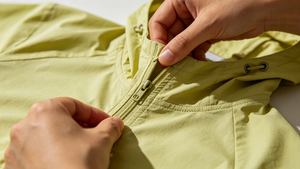
Stitch density should be uniform with no skipped stitches. Zippers and snaps should be smooth and secure. Neckline and cuff finishing should have no raw edges. Measure garment length, chest, shoulder width, and sleeve length. Deviations should be controlled within order requirements to avoid issues such as short sleeves exposing the palm or a too-short sun hat brim.
4.4 Simple On-Site Functional Tests
Place fabric over a cup mouth and blow air through it—more moisture vapor means better breathability. If water resistance is required, drip a few drops of water to test water repellency. A UV-sensitive card can be carried on site for auxiliary judgment, but UPF and UVA hard indicators must be sent to a third-party laboratory for testing. For quick-dry clothing, grab samples and send them for wicking height and evaporation rate testing.
4.5 AQL Sampling Judgment
Draw samples according to the international General Level II standard. Critical defects acceptance level AQL 0, major defects AQL 2.5, minor defects AQL 4.0. All inspection records should be organized into a handwritten report on site, with photos archived.
5. Frequently Asked Questions
5.1 What Is the Difference Between UPF50+ and UPF100+ for Sun Protection Clothing? Which Does the National Standard Recognize?
The highest legal labeling grade for sun protection textiles in the national standard is only UPF50+. There is no basis for labeling UPF100+ or UPF2000+. The national standard defines UPF50+: textile UV transmittance ≤2%, UV blocking rate ≥98%. The marketed UPF100+ blocking rate is about 99%. The protection difference between the two is only about 1%, and actual protection is almost the same—a typical case of over-marketing. If such non-compliant labeling is found during inspection, it can be directly judged as labeling non-compliance.
5.2 Is Performance Decline After Several Washes a Quality Problem for Quick-Dry Clothing?
It depends on the extent of decline. FZ/T 73077-2024 requires that after 30 standard washes, moisture absorption and quick-drying performance still meet standard requirements. Some coating processes or inferior original yarns fail after only 5–10 washes. If the decline exceeds the specified range, it is judged non-compliant. Pre-shipment inspection should require the factory to provide test data after 30 washes.
5.3 What Are the Quick Methods to Judge the Effectiveness of Sun Protection Clothing Before Shipment?
A UV-sensitive card on site can provide a preliminary judgment of whether there is some blocking ability, but it cannot fully replace laboratory testing. The card only reflects immediate blocking effect and cannot determine comprehensive UPF and UVA values. All products must be based on third-party laboratory test reports.
5.4 What Items Are Included in Major Defects for Sun Protection Clothing in AQL Sampling?
Major defects include: UPF or UVA transmittance not meeting standards, hangtag missing execution standard number or UPF grade, missing or inconsistent labeling information, and serious sewing quality problems affecting wear. Minor defects include: minor loose threads, size deviation within acceptable range, and minor packaging flaws.
The functional selling points of sun protection and quick-dry clothing are a double-edged sword. False UPF claims, failure to meet moisture absorption and wicking standards, and incomplete labeling—any one of these problems can cause a container to be stuck at customs or trigger batch returns. Before receiving the final bulk shipment, a third-party inspection agency with CMA/CNAS qualifications must execute a complete inspection process covering standard verification, labeling inspection, fabric performance, and workmanship details.
If you have specific questions about export apparel quality inspection or face practical difficulties in supply chain quality control, contact us for a one-on-one targeted solution.
Share this product
Functional Apparel Inspection Guide: UPF, Quick-Dry Performance, and L
Functional apparel is growing fast, but UPF mislabeling and quick-dry failures cause returns and customs issues. Learn the 3 inspection blind spots and the core pre-shipment process.