

Inspection methods, procedures and precautions for agricultural cranes
Agricultural cranes are important equipment for material handling and short-distance lifting in rural areas. They are usually mounted on agricultural transport vehicles or tractors and equipped with hydraulic lifting arms. They have relatively simple structures, low purchase costs, and low operational barriers. They are widely used in rural construction, grain collection points, small factories, and other places. However, precisely because of "many non-standard modifications, insufficient operation training, and weak safety awareness", the accident rate of agricultural cranes remains high - problems such as the legs not being fully extended causing overturning, broken steel wire ropes, overloaded and bent lifting arms, and loose and fallen connecting bolts of the slewing bearing are common. In scenarios such as new machine delivery, second-hand transactions, rural cooperative asset inventory, and annual safety inspections, a targeted inspection covering the lifting arm structure, hydraulic system, leg stability, steel wire rope and hook, and safety devices is a basic requirement for ensuring the safety of personnel and property during rural lifting operations.
I. Overview of Inspection Methods
Based on the vehicle type of agricultural cranes (tractor chassis/tractor coupling/independent base), the type of lifting arm (straight telescopic/rotating arm), the type of outriggers (H-type/Frog-type/Simple support), the power source (vehicle-mounted drive unit/independent diesel engine/electric motor) and the specific requirements of the client, the inspection comprehensively employs the following methods:
Static comprehensive inspection: The crane is stationary. The chassis/base of the carrier, outriggers, slewing mechanism, lifting arm, steel wire rope, hook, hydraulic system, and electrical control system are inspected item by item through visual inspection, touch measurement, and use of measuring tools.
Dynamic performance test: Verify the smoothness, speed and control response of actions such as leg retraction and extension, boom extension/reduction, rotation, lifting/lowering, etc. on a safe site.
Load test: Using a known mass of heavy objects, the lifting capacity, structural stiffness and leg stability of the crane under the rated load are verified.
Safety device verification: Check the effectiveness of each function such as over-rolling protection, balance valve, hydraulic lock, and leg interlock (if any).
Document and label traceability: Verify the main machine label (if any), the label of the lifting arm, the wire rope specification certificate, and the compliance of modifications (particular attention should be paid to non-standard modifications commonly seen in rural areas).
The third-party inspection consists of a complete package including "static full inspection + dynamic performance test + safety device verification + load test". If any safety device is missing or fails, the inspection result will be immediately rejected.
II. Inspection Process
1. Data Collection and Preparation for Inspection
The client provides information on the agricultural cranes to be inspected, specifying the carrier type, boom model, maximum lifting capacity/lifting moment, leg type, manufacturing year, modification records (if any), applicable reference standards (such as referring to GB/T 3811, JB/T 8909 standards for simple lifting machinery, etc.). The inspector prepares: tape measure, vernier caliper, feeler gauge, wire rope diameter gauge, thickness gauge, hydraulic pressure gauge set, level gauge, walkie-talkie, known mass weights, etc.
2. Confirmation of Venue and Safety Conditions
The loading test site must be solid and flat. The bearing capacity under the legs must meet the lifting requirements. Soft ground must be covered with steel plates or sleepers to expand the bearing area. There must be no obstacles within the test radius. A warning line is set up in the inspection area. Inspectors must wear safety helmets, reflective vests and anti-shock shoes. The lifting commander and operator must have unified and clear command signals.
3. Inspection of the carrier chassis and leg system - The foundation of stability
Carrier chassis/base: Agricultural vehicle chassis - Check for cracks or weld repairs on the frame beams in the installation area of the rotating base and the leg connection area. Tractor-mounted type - Check the strength and weld condition of the rear axle suspension connection parts. Independent base type - The base structure has no deformation, the welds have no cracks, and it is firmly in contact with the ground.
Legs: The leg box is free from deformation, cracking, or welding repairs. The leg extension and retraction movements are smooth. The mechanical locking pin or plug is reliably inserted after full extension. The coating on the piston rod of the vertical leg cylinder is undamaged. Hydraulic lock function - After the legs bear the load, the directional valve is closed and the cylinder should not noticeably retract on its own. The leg foot plate/base is in good condition, and the connecting pin shaft is firmly fixed. Whether the leg configuration meets safety requirements - The distance between the left and right legs should be sufficient to ensure the lateral stability of the entire vehicle.
Leveling instrument: Simple leveling instrument or visual leveling. After the legs are supported, the rotating plane of the turntable should be level.
4. Rotation System Inspection
Swing support: Check for tightness of connecting bolts (using tapping method or torque sampling). The gear ring has no broken teeth or severe wear. The sealing strip is intact and there is no leakage of lubricating oil. During operation, listen throughout the process for any periodic abnormal sounds - if any, issue an alert.
Rotation mechanism: Rotation motor / reducer or manual rotation mechanism (common in small machines) has no oil leakage, and the braking or locking function is effective.
Central rotary joint (if equipped): The hydraulic central rotating body has no leakage.
5. Inspection of the arm frame system
Arm appearance: The surfaces of each section of the telescopic or folding arm have no collision depressions or severe rust. The heat affected zones of the welds - at the arm head and arm tail, the reinforcing plates, and the slider seats - should be inspected for cracks using a strong light flashlight.
Extension/Folding Mechanism: The extension sequence of the telescopic arm is correct, and the movement is smooth. The gap between the slider and the wear-resistant pad is measured using a feeler gauge. The gap between each hinge pin and the bushing of the folding arm is inspected, and the lubrication is good. The logical sequence of the folding arm's movement (verified through the sequence valve) is confirmed.
Lift arm straightness: When fully extended, visually check for lateral deviation of the arm head. There should be no permanent deformation caused by overload. Overloading of agricultural cranes is common, and bending deformation of the lift arm is a frequent defect.
6. Boom and Lifting System Inspection
Lifting cylinder: Measurement of the gap between the cylinder ear seat pin and the shaft shows no leakage throughout the full stroke. Function of the balance valve - When the operating valve returns to the neutral position, the boom should reliably stop and there should be no obvious downward movement on its own. Failure of the balance valve is the main cause of the boom losing control and falling.
Lifting winch / hoist: Inspection of the fixed bolts of the winch base. The reducer shows no oil leakage and there is no abnormal noise during operation. The brakes are responsive. The condition of the rope groove on the drum. Small agricultural cranes often use electric winches. Check the motor operation and braking function.
Wire rope: Measure the entire length using a diameter gauge at multiple points. The wear should not exceed 7% of the nominal diameter; if the number of broken wires in one twist length reaches the scrap standard, it should be immediately scrapped. Check for broken strands, twists, rust, and rope core extrusion. Wire end fixation - the number and direction of wire clips comply with the standard (at least 3, alternating in forward and reverse directions), and the alloy casting joints have no cracks. Poor maintenance and severe rusting of agricultural crane wire ropes are common problems.
Pulley system: All pulleys rotate smoothly. The rope grooves have been measured using a caliper and the anti-detachment rope device is in good condition.
Hook: The surface is free from cracks, the opening deformation is no more than 15% of the original size, and the anti-detachment hook spring is effective. Agricultural hoist hooks are often homemade or of unknown origin. Therefore, it is necessary to carefully check their material and manufacturing quality.
7. Hydraulic System Inspection
Hydraulic oil tank: The liquid level is within the scale range and the color of the oil is normal. If possible, take samples.
Hydraulic pump: Power take-off driven type - The function of the power take-off's engagement and disengagement is normal, and there is no leakage from the hydraulic pump housing. Independent diesel engine/motor driven type - Check of the power source status.
Multi-way valve and hydraulic cylinder: Each control valve core operates flexibly without sticking, and the valve body has no oil leakage. Each functional hydraulic cylinder - such as outriggers, luffing, telescopic, folding, etc. - the piston rod is undamaged and there is no sinking during pressure retention.
Cable: Check the aging and cracking of all cables one by one. Focus on inspecting the interference and friction points between the cables and the boom, as well as the frame. Failure to replace the cables in agricultural cranes in a timely manner increases the risk of aging and burst cables.
8. Electrical and Control System Inspection (if equipped)
The buttons of the wired remote control and the wireless remote control handle all function properly. The emergency manual operation function is effective.
The torque limiter (if equipped) has no fault codes and the overload alarm function has been verified.
The warning lights and buzzer functions of the equipment are working properly.
9. Special verification of safety devices - Protection must be verified item by item.
Overwind protection (if equipped): Slowly raise the hook close to the boom head, and verify that the overwind protection automatically cuts off the lift and triggers an alarm.
Balance valve: Boom cylinder balance valve - The boom stops when the valve is in the neutral position, and there is no self-sliding.
Hydraulic Lock: Leg Vertical Cylinder Hydraulic Lock - The legs shall not retract automatically after bearing the load.
Emergency Stop: The emergency stop button or the engine shutdown switch functions properly.
Leg interlock (if equipped): When the legs are not fully extended, the system prevents the boom from moving in dangerous directions.
10. Dynamic performance and load test
No-load test run
The outriggers were retracted and extended twice, and the locking was secure.
The lifting, slewing, telescoping/folding, and rotation actions of the boom all operate at full speed and with smooth micro-motion, and the combined actions are coordinated.
The lifting and lowering movements are smooth, and the braking is reliable.
Rated load test
Select the nominal maximum lifting capacity of the crane (or the rated load under the commonly used working range), lift the corresponding load, and hover 200mm off the ground.
Check that the structure deformation is normal and that the legs do not lift off the ground.
The lifting, rotation and luffing actions are well-braked, and the heavy load does not slide down.
Hover for at least 5 minutes and measure the amount of weight that sinks.
Overload test (Carry out with caution)
Only conduct a 1.1 times dynamic load test when there are clear requirements and adequate safety measures in place. Agricultural cranes may have less structural strength margin than industrial cranes, and the risk of overload testing is high. Such tests must be carried out by experienced personnel under strict supervision.
Comprehensive re-examination after the test
Critical welds of the boom, bolts of the slewing bearing and gear ring, legs and locking mechanism, all hydraulic connectors and cylinder seals, wire ropes and hook condition.
11. Report Output
Summarize all inspection items, measurement data, load test records and safety device test results, and form the "Third-party Agricultural Crane Inspection Report". Clearly mark the items as qualified, general defects, serious defects and observation items. Special records and risk assessments must be made for non-standard modifications commonly found in rural areas.
III. Notes
Non-standard modifications - The greatest variable in agricultural crane inspection
In rural areas, there are a large number of agricultural cranes that have been privately modified or assembled in small workshops. The inspectors must:
Verify whether the boom of the crane is compatible with the load-bearing capacity of the chassis/base. Installing a heavy-duty boom on the frame of a simple agricultural vehicle is one of the main causes of overturning accidents.
Inspect the welding quality - The weld seams of the self-made boom and self-made legs must be inspected one by one. In rural areas, ordinary welding rods and arc welding are commonly used, and the quality of the weld seams varies greatly. There is a high probability of defects such as undercut, incomplete fusion, and pores.
Verify the sources of safety components such as steel wire ropes and hooks - whether they are products from reputable manufacturers and whether they have qualification certificates. If steel wire ropes that have been scrapped are used to modify or non-standard homemade hooks are employed, they must be determined as unqualified and the use must be immediately stopped.
Operator Safety Habits - Observations and Reminders During Inspection
The operators of agricultural cranes are mostly non-professionals and have weak safety operation awareness. During the inspection process, the inspectors should observe:
Are there often irrelevant personnel staying within the working radius of the crane?
Are the outrigger pads/steel plates being used as per the regulations? (Using pads on soft ground is a major cause of overturning accidents.)
Are there any signs of illegal operations such as slanting lifting and lowering, or dragging heavy objects with the hook (the deformation of the boom's side and abnormal enlargement of the hook's opening can reveal such behaviors)?
Legs - The Final Line of Defense for the Stability of Agricultural Lifters
The ground in rural areas is mostly made of soil, sand, or simple cement flooring, and its bearing capacity is much lower than that of industrial factory floors. During the inspection, the following steps must be taken:
Verify whether the contact area between the base of the legs and the ground is sufficient. The leg plates are too small and are prone to sinking on soft ground.
Does the span after fully extending the outriggers meet the stability requirements for lifting the load? Users often perform lifting operations without fully extending the outriggers in order to adapt to narrow spaces, which is an extremely dangerous violation. The inspector should clearly warn in the report.
Steel wire ropes and hooks - the lifeline cannot be compromised
The steel wire ropes of agricultural cranes are stored outdoors for a long time, exposed to sun and rain, which causes rusting and lubrication failure. Their lifespan is much shorter than that of industrial cranes. During inspection, the scrapping standards must be strictly followed, without being influenced by the notion that "it's for agriculture, just make do with it". The absence of the anti-detachment spring clips on the hook is a very common defect. Hooks without the clips are prone to detaching when the lifting rope shakes, and must be rectified immediately.
Key points for photo archives
The nameplates of the entire machine and the boom (if present), the condition of the carrier chassis, the panoramic view of the full extension of the legs, close-up shots of the wire rope defects, measurement of the opening degree of the hook, the weld condition of the boom, close-up shots of the modified welding areas, and the contact state of the legs with the ground during the load test, all need to be independently and clearly archived. The welds of non-standard modifications should be photographed from multiple angles for retention.
Share this product
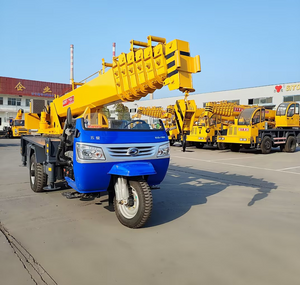
Inspection methods, procedures and precautions for agricultural cranes
Agricultural cranes are important equipment for material handling and short-distance lifting in rural areas.