

Standards for Appearance Inspection and Quality Testing of Jewelry Products - Guidelines for Inspection, Factory Inspection and Inspection Certification
To ensure that jewelry products such as necklaces, bracelets, anklets and stud earrings meet quality requirements, inspectors should conduct appearance inspections and relevant performance tests in accordance with unified standards. The following content can serve as a technical reference during the inspection of goods, factory inspection and certification processes.
I. Visual Inspection
(1) Appearance inspection of necklaces, bracelets and anklets (Basic inspection)
Overall structure: Stretch the chain horizontally to both sides and observe if it breaks. Check for any foreign objects (such as halved rings, etc.). The overall appearance of the product is good, the color of the coating is normal, and there is no peeling, dirt or missed coating.
Fastener function: Repeatedly open and close the switch on the lobster buckle, spring buckle, flip buckle or pendant to observe whether the lock buckle is flexible. This is a functional test.
The firmness of the hanging piece: Gently pull the hanging piece to confirm that it is installed firmly.
Casting quality: No flash, residue at the pouring port, scratches, abrasions, etc.
Small connecting parts: Check the eyepin, tin-pin, jump ring, bail ring, oval ring, etc. The joints should be neat and without any gaps.
Decorative materials
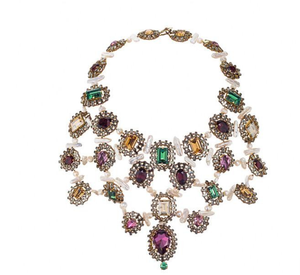
Gemstones: The color meets the requirements, the installation position is centered, the amount of glue is appropriate, and the gemstones are uniform.
epoxy resin: Good appearance, no excess and no flowing.
Other decorative components: Similar requirements.
The above appearance inspection results should be recorded in the inspection report and serve as the basis for evaluating the factory's technological level during the factory inspection.
(2) Visual inspection of ear studs
Pairing check: For ear studs with left and right distinctions, there must be no left-left or right-right pairing errors.
Overall appearance: The coating color is normal, with no peeling, dirt or missed coating.
Ear needle type examination
Fishhook-type ear needles: Length deviation ≤5%, and the ear plug should be neither too tight nor too loose.
Surgical knife type auricular needles: The auricular needles are vertically welded without tilting or bending. The ear plugs should be neither too tight nor too loose.
Lever-type ear needles: The ear needles do not bend. The mechanical movement of the hinge and the closing part is flexible.
Lever spring type ear studs: The mechanical device is flexible and can be freely opened and closed.
Ear clip type: The fit is neither too tight nor too loose, and the mechanical device is flexible.
These inspection items are directly related to the wearing safety and comfort of the products and are the key points of inspection.
Ii. Relevant Tests (Performance Inspection and Certification)
(1) Drop test (combined with firmness inspection)
Objective: To check the firmness of the combination of gemstones or components.
Method: After applying the adhesive for 72 hours, select the test surface as per the customer's requirements (use steel plates for base metals and wooden boards for precious metals). The sampling quantity is at the S-1 level, from a height of 1.5cm (or 36 inches?) The original text "Min5/8" (1.5cm) steel plate, 36 "x10 times" might be incorrect, usually 36 inches in height. But according to the original description: 36 inches in height, 10 drops, the first drop with the stone facing down. The kits are tested separately. If glass, stone or shell breaks, it will automatically switch to a wooden board for testing, and the result of the second drop will be used for determination.
Judgment: Score based on the table. This test is a key item in the inspection process for simulating transportation or using drops.
(2) Coating Testing (Insulation Inspection)
Objective: To confirm that the surface varnish coating of silver-plated or copper-plated products is intact (to prevent oxidation).
Method: Use a multimeter to test whether the surface is conductive. If it conducts electricity, the coating will be damaged (if there is a coating, it should not conduct electricity). This item belongs to the non-destructive electrical performance test in the inspection.
(3) Gemstone adhesive testing (Bonding strength Inspection)
Objective: To check the firmness of the gemstone adhesive.
Method: Press the gemstone surface onto the Stik-Tak mortar, quickly lift the product, and observe whether there are any gemstones falling off.
(4) Tensile testing (Structural strength inspection)
Objective: To check the strength of necklaces, bracelets and other chains.
Method: First, test all samples with normal force (3-4 pounds); If all pass, two more items will be randomly selected for a pull-scale test (8 pounds for base metals and 5 pounds for precious metals). If the normal force test fails, 20 items will be randomly selected for the weighbridge test, and 19 of them are required to pass.
Note: The tail chain should be pulled together. Multiple strands of chains are tested respectively, with the internal chain weighing 8 pounds and the external chain weighing 5 pounds. Tensile testing is an important indicator for evaluating the durability of products in certification.
(V) Elongation test of elastic rope
Objective: To examine the elastic recovery capacity of the elastic rope.
Method: Stretch the rope to twice its original length and repeat this process five times without breaking or causing permanent dimensional changes. This test is applicable to elastic jewelry such as bracelets.
(6) Accelerated nickel testing (Chemical Safety Inspection)
Objective: To test whether the product contains nickel (to avoid skin allergies).
Method: Use the electrochemical displacement method (apply 3V direct current to a solution with pH≈3.5 for 3 minutes, connect the product to the positive terminal and the carbon rod to the negative terminal, and then swap the polarities after 10 seconds). Wipe the surface of the product with a test paper. If it turns red, it contains nickel.
Correlation: The EU REACH regulation and some national certification standards have restrictions on nickel release, making this test mandatory.
(7) Vulcanization /Te test (anti-color change test)
Objective: To test the anti-sulfidation performance of the surface coating of silver-plated products.
Method: Immerse the product in a 3% potassium sulfide solution for 2 minutes, then clean it and observe the blackened area. For copper-plated or silver-burned products, soak them in a 10% hydrochloric acid +0.25%TeO₂ solution for 10 seconds.
Judgment (taking S-1 sampling of 5 items as an example) :
If the discoloration of any one item exceeds 50%, it will be considered unqualified
If two items change color by 20-50%, they are considered unqualified
If one piece changes color by 20-50%, it is qualified
All discolored areas less than 20% are qualified
(8) Gold plating Test (Coating Thickness inspection)
Objective: To test whether the thickness of the coating meets the requirements.
Method: Use an X-Ray fluorescence coating thickness gauge (X-ray) to scan the surface of the product. This inspection is a commonly used method for measuring the quality of coatings in certification.
(IX) Torque Testing (Welding Strength Inspection)
Objective: To inspect the strength of metal welding points.
Method: Apply 2 inches · pounds (approximately 0.23N·m) using a torque wrench, first clockwise and then counterclockwise. If the component deforms, it can be twisted to 90% of its maximum value without breaking, which is considered passing. If the test value is not reached when twisted to 90 degrees, it is also regarded as passed.
Iii. Association between Factory Audit and Certification
Supplier factory inspection: It is necessary to verify the casting, welding, electroplating, assembly, testing and other processes of the jewelry manufacturing enterprise. Calibration records of inspection equipment (such as X-Ray thickness gauges, torque meters, tension scales, multimeters, etc.); Qualifications of inspection personnel; And the control process for hazardous substances (such as nickel, lead, cadmium, etc.).
Product certification: Exported jewelry must comply with the certification standards of the target market (such as EU REACH, US CPSIA, China GB 28480, etc.). When inspecting the goods, check the consistency between the product labels, instructions and certifications.
Continuous improvement: For non-conformities identified during inspection (such as coating peeling and welding point breakage), a rectification report should be formed, followed up in a closed loop through factory inspection, and a quality traceability file should be established.
Through the above inspection, testing, factory inspection and certification processes, it can be ensured that jewelry products fully meet the standards in terms of appearance, mechanical performance, chemical safety and other aspects, reducing trade risks and enhancing brand reputation.
Share this product
Standards for Appearance Inspection and Quality Testing of Jewelry Pro
Standards for Appearance Inspection and Quality Testing of Jewelry Products - Guidelines for Inspection, Factory Inspection and Inspection Certification